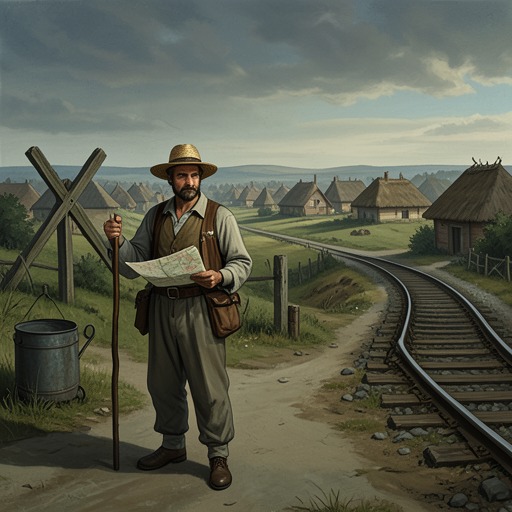
Antek decides to stay and await trial
The PeasantsAntek Boryna’s decision to stay and await trial turns a moment of private panic into a hard, provisional commitment to his family and land. Faced with the prospect of imprisonment, he imagines selling everything and fleeing with his household; Hanka Borynowa answers with an equally stark refusal, then promises to hold the farm together while he serves his time. The choice does not resolve the danger before them. It replaces flight with waiting, and makes Hanka’s determination the condition on which that waiting becomes bearable.
The incident and the fear of flight
The episode follows an unsettling visit by a sergeant. He claims to be on duty at Maciej Boryna’s, but is partly appeased by eggs and fresh butter. Witek follows the visitors and later recounts their unsuccessful attempt to peer through lit windows: dogs bark, preventing them from looking in covertly, and they leave with nothing. The account gives the visit an atmosphere of intrusion and suspicion without establishing exactly what the men hoped to discover. The narration says that the incident strangely unsettles Antek, then shifts from the attempted surveillance outside to a confession indoors.
Alone with his wife, Antek begins to speak of his troubles. The conversation’s stakes become plain when he says there is nothing left to do but sell up and run away, even to America. Flight is not presented as a completed plan: it is the desperate possibility he raises while imagining that his present life has become untenable. But selling up would mean relinquishing the household’s material foothold, while leaving would draw Hanka and the children into the consequences. His suggestion therefore makes the family’s survival—not only his own fate—the immediate subject of the scene.
Hanka’s refusal and vow
Hanka listens carefully, her heart thumping, and lets Antek speak without interrupting him. Her response comes only when he proposes escape. She stands pale as a wall and threatens that she will neither go nor permit the children to be lost in the world. Her words escalate into a terrible conditional vow: if he forces the departure, she says, she will kill the children with an axe and throw herself into a well. The text gives the threat as an expression of extremity, not as an enacted plan; it shows how completely she rejects the future Antek has proposed.
The gesture that follows changes the force of her speech. Kneeling before the holy pictures, Hanka makes her refusal resemble a solemn oath, invoking God as witness. Her resolve is at once emotional and practical: she will not let the children be carried into ruin, and she will not accept the abandonment of the farm as inevitable. Antek answers, “Hush! Why, I’m just talking!” His reply recasts his proposal as speech rather than settled intention. It does not erase the fear that produced it, but it gives Hanka room to draw breath. After the threat and vow, she quiets and speaks through tears.
A decision to wait
Hanka’s second response is not another threat but a promise of endurance. She tells Antek that he will serve his time and return, and insists that she can manage in his absence. She promises not to lose a single strip of land and says he does not yet know what she is capable of holding onto. Her pledge makes the land concrete: what Antek’s escape would put at risk is not an abstraction but the farm’s separate strips, which Hanka intends to keep in her grip. She also places her confidence within religious dependence, saying that with the help of the Lord Jesus she will bear the scourge, and she cries quietly as she speaks.
Antek does not answer with certainty about the case’s outcome. He ponders for a long time, then accepts uncertainty: “It’ll be as God wills it! We must wait for the case.” The decision is therefore limited but consequential. He abandons, at least for now, the prospect of selling up and fleeing; instead, he agrees to await the legal proceedings and the time they may impose. The passage does not say that his trial has taken place or that he has been sentenced. Its ending is a choice to remain through uncertainty, not a report of release or resolution.
Family, land, and the failed alternative
The scene gives Hanka a decisive role in redirecting the household’s course. Antek voices the wish to escape, but she identifies what flight would cost the children and the family’s land, and offers to shoulder the work of keeping both from being lost. The movement from her bodily alarm to her quieter promise makes her commitment visible as more than a reply: she listens, reacts, invokes the holy pictures, and then turns fear into an undertaking. Antek’s eventual agreement follows her declaration that she will manage, though the passage does not suggest that the burdens have thereby disappeared.
The closing observation that Antek’s Brother-in-law’s cunning schemes have come to nothing places this intimate decision against a wider struggle over the household’s future. The episode does not detail those schemes here, so their precise form remains unstated; it does establish that they have failed. In the immediate scene, the decisive alternative is no longer a plan made on Antek’s behalf by others, but the couple’s agreement to wait for the case. That agreement is fragile: its hope rests on divine will, Hanka’s labor, and the preservation of land through Antek’s absence. The unresolved trial keeps the ending open, while Hanka’s vow gives the household a course to follow until its outcome is known.